
How Artificial Intelligence Is Quietly Reshaping Job Security
As automation begins to influence how companies operate, many professionals are rethinking how dependent they should be on a single source of income.

Artificial intelligence is gradually becoming part of everyday business operations. Across industries, companies are adopting AI-driven tools to automate tasks that once required significant human effort. From data analysis and customer service to content generation and financial modeling, automation is increasingly integrated into how modern organizations function.
Rather than replacing entire professions overnight, the technology is quietly reshaping how many jobs are performed. Routine tasks are being handled by algorithms, allowing businesses to operate faster and more efficiently than before.
As this shift unfolds, many professionals are beginning to reconsider how stable traditional career paths may remain in the years ahead. The conversation is slowly moving beyond job titles and promotions toward a broader question: how dependent should one be on a single source of income in an increasingly automated world?
How AI Is Reshaping Traditional Careers
Across industries, artificial intelligence is gradually taking over routine and repetitive tasks that once required considerable human effort. Businesses increasingly rely on AI systems to process large volumes of information, analyze patterns, and automate workflows that previously consumed hours of manual work.
In marketing, AI tools are now capable of generating content, analyzing campaign performance, and optimizing advertising strategies in real time. Customer support departments are using intelligent chat systems to handle large volumes of inquiries, often resolving common issues before a human agent becomes involved. In finance and accounting, AI-driven platforms assist with data analysis, fraud detection, and financial forecasting, allowing teams to process complex information more efficiently.
The technology is also beginning to influence fields such as software development, where AI-assisted coding tools help programmers write and review code faster. In many cases, the goal is not to eliminate human roles entirely but to increase productivity by allowing machines to handle repetitive processes.
For companies, these efficiency gains are difficult to ignore. Organizations across sectors are steadily adopting AI-powered tools to streamline operations, reduce costs, and improve decision-making.
The transformation, however, is not happening overnight. Instead, it is unfolding gradually—task by task, workflow by workflow. Yet over time, these incremental changes are quietly reshaping how many professions operate, altering the skills that professionals need to remain competitive in an evolving workplace.

Why Job Security Is Becoming Less Predictable
The pace of technological change has accelerated significantly in recent years. Advances in artificial intelligence, automation, and digital infrastructure are reshaping industries faster than many professionals had previously experienced. Entire workflows that once remained stable for decades are now evolving within just a few years.
As companies adopt new technologies to remain competitive, job roles are also changing. Tasks that once formed the core of certain professions are gradually being automated or redesigned. In many cases, professionals are expected to adapt by learning new tools, acquiring new skills, or shifting toward roles that require greater strategic or creative input.
This rapid evolution also means that skills can become outdated more quickly than in the past. Knowledge that was once considered specialized may now be supported—or in some cases replaced—by advanced software systems capable of performing similar functions at scale.
In response, professionals across industries are beginning to reconsider how much they rely on a single career path for long-term financial stability. Rather than viewing employment as a lifelong certainty, many are starting to think in terms of adaptability, continuous learning, and diversified sources of income.
The idea of building financial resilience is gradually moving beyond traditional notions of job security, encouraging individuals to explore ways of strengthening their financial position outside the boundaries of their primary profession.
The Rise of Parallel Income Streams
As the nature of work continues to evolve, many professionals are beginning to rethink how they approach income and financial stability. Rather than depending entirely on a single salary, there is a growing trend toward building additional income streams alongside one’s primary career.
Freelancing and consulting have become common ways for professionals to apply their expertise beyond their regular roles. Digital platforms have also made it easier for individuals to build small businesses online, whether through content creation, e-commerce, or specialized services delivered remotely.
At the same time, financial markets are attracting increasing attention from individuals looking to participate in the broader economy beyond their day jobs. Investing and trading allow people to engage with businesses, industries, and global economic trends in ways that extend beyond traditional employment.
For many professionals, these parallel income streams are not necessarily intended to replace their careers. Instead, they represent a way to strengthen financial resilience by creating multiple channels through which income can be generated.
In an environment where industries can shift quickly and technological change continues to accelerate, this approach reflects a broader mindset: building financial stability through diversification rather than relying on a single source of earnings.

Why the Stock Market Continues to Matter
While industries and technologies continue to evolve, the stock market has remained a central part of economic systems for centuries. Long before the digital age, stock exchanges provided a platform through which businesses could raise capital and investors could participate in economic growth. Over time, the tools and technologies used to access the stock market have changed, but the underlying mechanism has remained remarkably consistent.
The stock market tends to adapt to shifts in technology rather than being replaced by them. From open-outcry trading floors to electronic exchanges and algorithmic trading systems, each wave of innovation has transformed how the stock market operates while preserving its fundamental role in the economy.
At its core, the stock market reflects the activity of businesses across industries. As companies grow, innovate, and compete, their performance is often mirrored in market movements. This relationship allows the stock market to act as a bridge between businesses seeking capital and individuals looking to participate in economic progress.
Because of this, the stock market continues to remain relevant even as industries transform. While specific professions may evolve or disappear with technological change, the flow of capital and investment through the stock market persists—making it a consistent feature of modern economic life.
Learning How the Stock Market Works
While the stock market is accessible to anyone with an internet connection, participating in it effectively requires more than simply opening a trading account. The market operates on complex dynamics influenced by economic data, corporate performance, global events, and investor psychology. Understanding how these forces interact often takes time and careful study.
Successful participation in the stock market also demands discipline and sound risk management. Decisions driven purely by emotion or speculation can quickly lead to losses. Many experienced traders and investors emphasize the importance of structured strategies, clear entry and exit rules, and a consistent approach to managing risk.
For beginners, this learning process can initially feel overwhelming. The volume of information available online often leads to confusion, with conflicting opinions and strategies making it difficult to know where to begin.
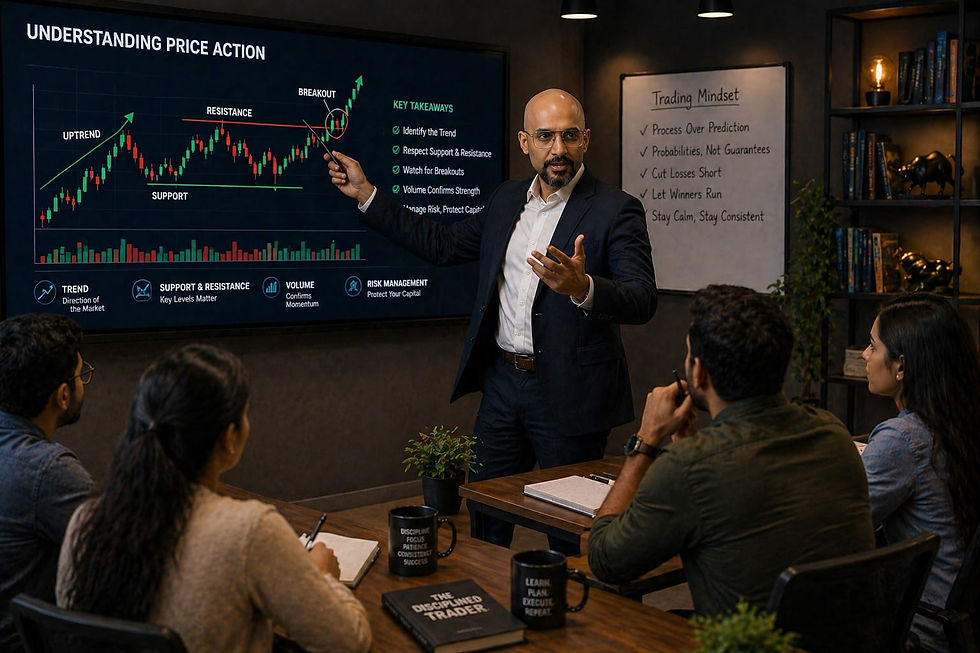
This is why many individuals choose to approach the stock market through structured education. Guided learning environments can help newcomers understand market behavior, technical concepts, and trading frameworks more efficiently than relying solely on trial and error. Over time, this foundation can make it easier to approach the stock market with greater clarity and confidence.
The Future Belongs to Adaptable Professionals
Technological change has always shaped the nature of work, but the pace of transformation today is noticeably faster. As AI continues to evolve, industries are likely to keep redefining how tasks are performed, how businesses operate, and what skills professionals are expected to develop.
In this environment, long-term career stability may depend less on holding a single role and more on the ability to adapt. Continuous learning, openness to new technologies, and the willingness to develop complementary skills are becoming increasingly important for professionals across sectors.
At the same time, financial literacy is emerging as a valuable capability in its own right. Understanding how the stock market works, how capital flows through the economy, and how individuals can participate in these systems can provide a broader perspective on income and financial growth.
For many professionals, the goal is not to replace their primary careers but to strengthen their overall financial position. Developing knowledge of the stock market and building diversified income streams can offer an additional layer of resilience in a world where industries, technologies, and career paths continue to evolve.
Interested in learning more?
For professionals interested in understanding how the stock market works and how trading is approached systematically, structured education can make the learning process significantly easier. Those who wish to explore the fundamentals of trading and market behavior can learn more here: https://learntradinglive.in
Siddharth Shirodkar Founder, The School of Dalal Street Stock market educator who has trained individuals in understanding financial markets and trading strategies.


Comments